
The best hardware wallets
Some links on this page are affiliate links. If you buy through them, we may earn a commission at no extra cost to you. It never changes what we recommend. How we make money
Short answer
The best hardware wallet for most people is the Trezor Safe 5 ($129).
- For phones: the Ledger Nano Gen5 ($179).
- Cheapest with a screen: the Trezor Safe 3 ($59).
- For an iPhone and a big screen: the Trezor Safe 7 ($249).
- For the largest screen of all: the Ledger Stax ($399), though the Flex does the same job for $150 less.
This page is researched from the makers' own shop and specification pages (read on 15 and 16 November 2026), published security research and every incident we could find for each maker in 2025 and 2026. We haven't tested the devices hands-on. We may earn a commission from Trezor, Ledger, BitBox and Tangem if you buy through our links. The order comes from the points under How we ranked them. The commission doesn't set it.
Crypto hardware wallets compared
| Hardware wallet | Best for | Screen | Chip | Phone without a cable | Price |
|---|---|---|---|---|---|
| Trezor Safe 5 | Most people | 1.54" colour touch | EAL6+ | No | $129 |
| Ledger Nano Gen5 | Phones | 2.8" E Ink touch | EAL6+ | Bluetooth, NFC | $179 |
| Trezor Safe 3 | Budget | 0.96" mono, buttons | EAL6+ | No | $59 |
| Trezor Safe 7 | iPhone, big screen | 2.5" colour touch | EAL6+ plus TROPIC01 | Bluetooth | $249 |
| BitBox02 Nova | Bitcoin only | Built-in | EAL6+ | Bluetooth | €175* |
| Ledger Flex | A big E Ink screen | 2.8" E Ink touch | EAL6+ | Bluetooth, NFC | $249 |
| Ledger Nano X | Cheapest Bluetooth | 1.1" mono, buttons | EAL5+ | Bluetooth | $99 |
| Ledger Stax | Largest screen | 3.7" curved E Ink touch | EAL6+ | Bluetooth, NFC | $399 |
| Tangem Wallet | No recovery words | None | EAL6+ | NFC | $54.90 |
* BitBox lists €145.83 before VAT; €175 includes 20% VAT. Other prices in US dollars from each maker's own shop on 15 and 16 November 2026, before shipping and tax. EAL6+ and EAL5+ are Common Criteria grades from an independent lab evaluation; 6+ is the higher one.

Trezor Safe 5
Best hardware wallet overall
$129Check price
The Safe 5 has a 1.54-inch colour touchscreen with haptic feedback, a certified EAL6+ secure chip and published device code that outside researchers can inspect. It connects by USB-C and has a microSD slot. Backup can be 12, 20 or 24 recovery words, a multi-share backup split across several cards, and an optional passphrase. It works with Trezor Suite and with more than 30 other wallet apps, MetaMask, Electrum and Sparrow among them.
Pros
- Touchscreen, certified chip and open code at $129
- Most flexible backup options here
- Works with 30+ other wallet apps
Cons
- Can't send, swap or be set up from an iPhone
- Partner leaks and a reseller implant case in 2026
The Safe 5 was the model in the CryptoBilis case. Units bought from CryptoBilis, a reseller in Southeast Asia, between 20 August and 23 September 2026 had an implant fitted inside. Trezor disclosed it in November 2026: 48 customers came forward, no funds were reported lost, and firmware 2.13.1 blocks the CryptoBilis implants. The implant was added by the seller. Buy from trezor.io. Our Trezor review covers it.
Skip it if your only device is an iPhone.

Ledger Nano Gen5
Best hardware wallet for phones
$179Check price
Ledger's newest Nano, launched in October 2025, has a 2.8-inch E Ink touchscreen, Bluetooth, NFC and USB-C, and up to about ten hours of battery. Its chip is rated EAL6+, and Ledger's app supports more than 500 coins directly. A Ledger Recovery Key, an NFC backup card, comes in the box. For most people who use crypto from a phone, this is the Ledger to buy.
Pros
- Bluetooth and NFC on iPhone and Android
- The cheapest Ledger touchscreen
- 500+ coins in Ledger's own app
Cons
- Plastic body
- Device operating system only "partially reviewable", in Ledger's words
Why not higher: device code that outsiders can't fully review, and Ledger's incident record (below). Skip it if you never use a phone for crypto; the Safe 5 is cheaper.

Trezor Safe 3
Best budget hardware wallet
$59Check price
The Safe 3 is the cheapest hardware wallet here with a screen of its own, and it has the same EAL6+ chip grade, coin support and backup options as the Safe 5. The screen is a 0.96-inch monochrome display with two buttons. In March 2025 Ledger's lab showed an attack on its main processor that needs the device in hand and lab equipment; Trezor said a determined attacker could "theoretically" use it on a stolen device (The Block).
Pros
- $59 for a certified chip and a screen
- Same backups as the Safe 5
Cons
- Small screen, two buttons
- Only balances, buying and receiving on an iPhone
Why not higher: the small screen makes long addresses slower to check. Read our Trezor Safe 3 review for whether it is enough.

Trezor Safe 7
Best premium hardware wallet
$249Check price
The Safe 7 adds everything the cheaper Trezors leave out: a 2.5-inch colour touchscreen at 700 nits, Bluetooth, a battery with Qi2 wireless charging, and IP54 splash protection. Bluetooth is what gives it full iPhone support. It carries two secure chips: the EAL6+ chip used across the range, and TROPIC01, a chip whose design is published for outside audit.
Pros
- The only Trezor that does everything on iOS
- Two secure chips, one auditable
- Largest Trezor screen, 700 nits
Cons
- $249, nearly double the Safe 5
- Bluetooth adds a connection to think about
Why not higher: for desktop and Android users, the Safe 5 does the same job for less. See our Trezor Safe 7 review.

BitBox02 Nova
Best hardware wallet for Bitcoin
€175Check price
The Nova comes in a Multi edition and a Bitcoin-only edition at the same price; you choose when you buy and can't switch later. The Bitcoin-only firmware is kept minimal, which is why Bitcoin holders like it. It has an EAL6+ chip, a screen, encrypted Bluetooth you can switch off, and a microSD backup option. BitBox fixed two firmware flaws in August 2026, in version 9.26.5, with no exploitation reported (Cointelegraph).
Pros
- Minimal Bitcoin-only firmware
- microSD backup option
Cons
- Euro pricing; check shipping
- Smaller coin range than Trezor or Ledger
Why not higher: price and a narrower coin range. Skip it if you hold more than Bitcoin and a few major coins.
Ledger Flex
Best big-screen Ledger
$249Check price
The Flex has a 2.8-inch E Ink touchscreen at 480 by 600 pixels, sharper than the Nano Gen5's 300 by 400, plus Bluetooth, NFC, an EAL6+ chip and around ten hours of battery. It weighs 58 grams. Next to the Stax it gives up the curved 3.7-inch screen and wireless charging, and saves $150. Nordic Crypto's Stax review makes the same point from the other side: the Flex has the "same security and track record" for $150 less.
Pros
- Sharper screen than the Gen5
- Same chip and connections as the Stax
Cons
- $70 more than the Gen5 for the same size screen
- Same price as a Safe 7
Why not higher: the Nano Gen5 does almost everything the Flex does for $70 less.

Ledger Nano X
Cheapest Bluetooth hardware wallet
$99Check price
At $99 the Nano X is the cheapest way to use a major maker's hardware wallet from a phone without a cable. It has Bluetooth, USB-C, a small 1.1-inch screen with two buttons, a battery Ledger rates at about five hours, and room for up to 100 apps. Its chip is rated EAL5+, one grade below every other device on this list.
Pros
- Bluetooth for $99
- Works with iPhone and Android
Cons
- EAL5+ chip, the lowest grade here
- Small screen and owners report battery wear
Why not higher: the chip grade and the small screen. Our Ledger Nano X review compares it with the Nano S Plus and the Gen5.

Ledger Stax
Largest hardware wallet screen
$399Check price
The Stax has the largest screen of any hardware wallet here: a 3.7-inch curved E Ink touchscreen of 400 by 670 pixels that wraps around to one side. Ledger says you can set a picture as its lock screen. It is the size of a credit card, 6 mm thick, charges wirelessly by Qi, and has Bluetooth, NFC, an EAL6+ chip and about ten hours of battery. Magnets let several stack together.
Pros
- Largest, clearest screen for long transactions
- Wireless charging
Cons
- $399, the most expensive device here
- Reviews mention touchscreen lag
Why not higher: it costs $150 more than the Flex. It adds a larger screen and wireless charging. The chip and connections are the same. See our Ledger Stax review.

Tangem Wallet
Best hardware wallet without recovery words
From $54.90Check price
Tangem is a set of NFC cards you tap on your phone. The same wallet sits on every card, so a spare card is the backup, and recovery words are optional. Two cards cost $54.90, three cards $69.90. It needs no battery and supports more than 14,100 tokens on 90 blockchains, by Tangem's count. There is no screen, so you approve what your phone shows you.
Pros
- Nothing to write down or lose
- Cheapest entry here
Cons
- No screen of its own
- A 2026 lab attack that can't be patched
Why not higher: without a screen, a compromised phone could show you one address while you sign another. Read our Tangem review.
How we ranked them
- A screen you can trust. A device that shows the payment itself protects you from a compromised computer or phone.
- Chip grade. EAL6+ ranks above EAL5+. Every pick except the Nano X has EAL6+.
- Published code. Trezor publishes its device code; BitBox publishes firmware for the original BitBox02; Ledger publishes its Ledger Wallet app code and calls its device operating system "partially reviewable": its agreement with the chip maker stops it publishing the low-level code for the secure chip (Ledger).
- Track record. What each maker's incidents put at risk: keys, devices or contact details.
- Price for what you get. A more expensive device has to add security or a real convenience. Size alone doesn't count.
- Ease of use. Phone support, screen size, and how simple the backup is.
Backup options by maker
The backup is what saves you when a device is lost, broken or stolen, and the makers handle it in different ways.
| Maker | Recovery words | Other backup options |
|---|---|---|
| Trezor | 12, 20 or 24 words | Advanced Multi-share Backup; passphrase; two 20-word backup cards in the box |
| Ledger | 24 words | Passphrase; Ledger Recovery Key card with the Gen5, Flex and Stax; optional paid Ledger Recover |
| BitBox | Not stated by BitBox | microSD card backup |
| Tangem | Optional | A second or third card holds the same wallet |
| See Trezor | See Ledger |
Multi-share backup on Trezor splits the backup across several cards, so one stolen card doesn't give away the wallet. A passphrase works the same way at both big makers: it is an extra word you choose, and it opens a separate set of accounts. Ledger describes it as a "25th word" of up to 100 characters. You can type it each time, or link it to a second PIN on the device. Ledger warns that if you forget it, "access to the associated hidden wallet is permanently lost", and that three wrong attempts at the second PIN reset the device (Ledger).
Ledger Recover is a paid subscription, run with Coincover, that keeps an encrypted copy of your backup in three pieces and returns it after an identity check. Ledger Academy lists it at $9.99 a month. It is opt-in.
Hardware wallet incidents in 2025 and 2026
The incident record is the question most buyers now ask about. Here is every incident we found for the makers on this list, and what it put at risk.
| When | Maker | What happened | What was at risk |
|---|---|---|---|
| Mar 2025 | Trezor | Lab attack on the Safe 3's processor, device in hand | Keys on a stolen device |
| Jun 2025 | Trezor | Contact form used to send phishing emails | Owners tricked by email |
| Jan 2026 | Ledger | Payment partner Global-e exposed order details | Names and addresses |
| Jul 2026 | Tangem | Laser attack resets a card's password, about $250,000 of equipment | Keys on a stolen card |
| Aug 2026 | Trezor | Shipping partner leak, 80,689 customers | Names, emails, addresses |
| Aug 2026 | BitBox | Two firmware flaws, fixed in 9.26.5 | None reported exploited |
| Sep 2026 | Trezor | Email service breach, phishing to about 347,000 addresses | Owners tricked by email |
| Aug-Sep 2026 (disclosed Nov) | Trezor | Reseller CryptoBilis sold Safe 5s with an implant inside | Recovery words of those buyers |
Ledger's older record is longer: a 2020 leak of about 272,000 customers' names and home addresses, and a December 2023 software library attack that drained roughly $600,000 from people using connected apps (BleepingComputer). Ledger's payment-partner leak is reported by The Block, and Tangem's lab attack also by The Block.
The pattern is clear. The two lab attacks needed the device in hand. The rest were leaks of contact details, followed by phishing, and one reseller selling tampered devices. The practical defences are the same for every brand: buy from the maker, and never type your recovery words into anything.
What Trezor did after CryptoBilis
Trezor's own post of 12 November 2026 says the implant was limited to Safe 5s sold by CryptoBilis, through its Tokopedia and Shopee stores and directly. Trezor cut its reseller network by about 80%, offered a new device to anyone who bought from CryptoBilis from March 2026, and told those owners to move their coins to a new wallet with new recovery words. It now recommends buying directly from trezor.io.
The August 2026 shipping leak exposed names, emails, phone numbers, shipping addresses and order numbers. It didn't touch devices or recovery words. The risk it left is phishing aimed at people known to own a Trezor.
How to check a device is genuine
Trezor ships its devices with no firmware installed, and says that if firmware is already installed "the device should not be used". The Safe 3, Safe 5 and Safe 7 have a tamper-evident holographic seal over the connector. Trezor Suite then runs authenticity checks during setup. Trezor's advice: "Never buy a Trezor from an unauthorized third party."
What a hardware wallet doesn't protect you from
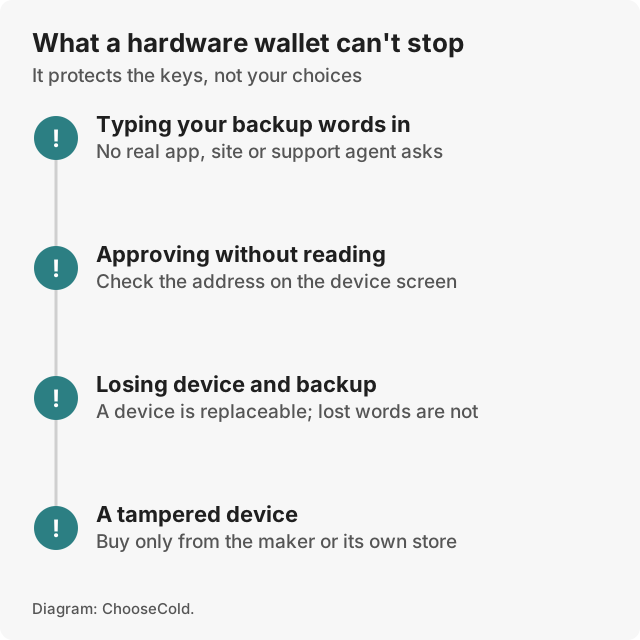
None of these is a flaw in the device. Each comes down to what the owner does, or where the device was bought. Read the address on the device screen before you approve, keep the recovery words offline and away from the device, and buy only from the maker's own shop or official store.
The best hardware wallet for beginners
For a first hardware wallet, the Trezor Safe 5 is the easiest to get right: the touchscreen guides you through setup, and Trezor Suite walks you through each step. If you use only a phone, the Ledger Nano Gen5 is the easier start, because it connects without a cable. If writing down and storing 20 or 24 words worries you, Tangem's cards remove that step, at the cost of a screen.
Whatever you buy, send a small test amount first. Then check the backup before you move your savings, so you know it works. Trezor Suite has a recovery check for this.
Best hardware wallet for altcoins and XRP
Trezor lists "1000s of coins & tokens", XRP and Solana included on all three Safe models. Ledger's own app supports more than 500 coins directly and more through other wallet apps, and Ledger says its hardware wallets can store XRP. Tangem claims more than 14,100 tokens across 90 blockchains, XRP Ledger among them. For a less common coin, check the maker's coin list before you buy: a few coins work on some models only.
Which hardware wallet should you buy?
| If you… | Buy |
|---|---|
| want one good default | Trezor Safe 5, $129 |
| use crypto mostly from a phone | Ledger Nano Gen5, $179 |
| are spending as little as possible | Trezor Safe 3, $59 |
| use only an iPhone and want Trezor | Trezor Safe 7, $249 |
| want Bluetooth for under $100 | Ledger Nano X, $99 |
| hold only Bitcoin | BitBox02 Nova Bitcoin-only, or a Trezor Bitcoin-only edition at the standard price |
| want the biggest screen | Ledger Stax, $399, or the Flex, $249 |
| don't want to write down words | Tangem, three cards, $69.90 |
| See Trezor |
What we left out
- Coldcard: a weak random number generator in its firmware from version 4.0.1 (March 2021) made recovery words easier to guess. Coinkite fixed it in firmware 5.6.0 for the Mk4 and Mk5 and 1.5.0Q for the Q, but an update doesn't repair words already created; owners have to move to a new wallet (Coinkite). TRM Labs estimates about $116 million in Bitcoin was taken (TRM Labs).
- Keystone 3 Pro: an air-gapped wallet that signs through QR codes. We couldn't confirm a standalone price from its shop.
- Ledger Nano S Plus ($69): an EAL6+ chip at a low price, but it has no battery or Bluetooth and doesn't work with an iPhone. The Safe 3 costs $10 less with more backup options.
Where to buy a hardware wallet
- The maker's own shop first: trezor.io, shop.ledger.com, bitbox.swiss, tangem.com.
- The maker's official Amazon storefront, if it has one. Avoid other sellers on the same listing.
- Never second hand, never from an auction, and never from a reseller you can't find on the maker's own list.
When the device arrives, check the seal, create a new wallet on the device, and use only the recovery words it shows you. Words printed in the box mean someone else knows them.
Questions people ask
What is the best hardware wallet in 2026?
The Trezor Safe 5 ($129) for most people: a certified secure chip, published code and a touchscreen. The Ledger Nano Gen5 ($179) is the best for phones, and the Trezor Safe 3 ($59) the best on a budget.
Is a crypto hardware wallet worth it?
Once you hold more than you would be happy to lose, yes. A hardware wallet costs $55 to $400 and keeps your keys away from malware on your phone or computer, and away from any exchange that could fail.
Is Ledger or Trezor better?
Trezor for published code and a lower entry price; Ledger for Bluetooth and phone use for less than a Safe 7. Our Trezor vs Ledger comparison goes model by model.
Can a hardware wallet be hacked?
The published attacks on the devices in this list need the device in hand and lab equipment. Most real losses come from people typing their recovery words into fake sites, approving payments they didn't read, or buying tampered devices.
What happens if my hardware wallet company goes out of business?
Your coins are on the blockchain. The company doesn't hold them. Your recovery words restore the wallet in any compatible wallet app or device, so you don't depend on the maker staying in business.
How long does a hardware wallet last?
Many years, and the coins don't depend on the device at all. Devices with batteries (the Nano X, Gen5, Flex, Stax and Safe 7) will lose battery capacity over time. Trezor says it will keep fixing security issues on its discontinued Model One and Model T until at least 2036.