
Tangem Wallet review: is it safe without a recovery phrase?
Some links on this page are affiliate links. If you buy through them, we may earn a commission at no extra cost to you. It never changes what we recommend. How we make money
Short answer
Tangem is a safe, simple cold wallet for people who don't want to write down and store recovery words. It is a set of two or three NFC cards that tap on your phone, from $54.90. Its weaknesses are the missing screen, which means you trust your phone to show the right address, and a 2026 lab attack that can't be patched. For large savings, a wallet with its own screen is safer.
How we reviewed it: from Tangem's product, pricing, security and help pages (read on 16 November 2026), the published audit summaries, Ledger Donjon's attack write-up and the press coverage of it, and owner and reviewer views on Trustpilot, Reddit, CryptoSlate and Cointelegraph. We haven't tested the cards hands-on. We may earn a commission if you buy through our links; that doesn't change the rating. The 7.6 rating weighs security design, ease of use, price and Tangem's record (see how we rate). It scores highest on ease and price and loses most for having no screen of its own and for the unpatchable 2026 attack.
Pros
- No recovery words to write down, unless you want them
- Certified EAL6+ chip, developed with Samsung
- From $54.90 for two cards
- No battery, no cable, waterproof and dustproof to IP69K
- More than 14,100 tokens on 90 blockchains, by Tangem's count
- 25-year limited hardware warranty
Cons
- No screen: you check payments on your phone
- A 2026 laser attack resets a card's access code; it can't be fixed by update
- Card firmware can't be updated at all
- Phone only, no desktop app
- You can't add a card to a wallet later
- Trustpilot rating of 3.9 from 1,036 reviews
How a Tangem wallet works
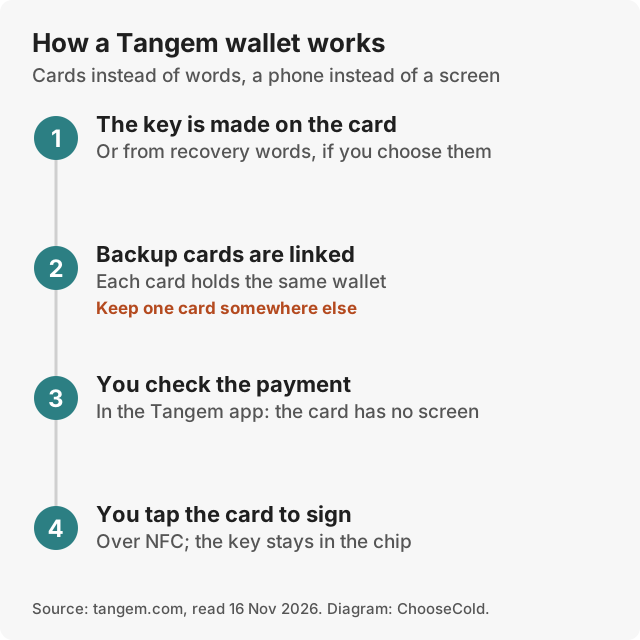
A Tangem wallet is a set of NFC cards, each with a secure chip inside. At setup, the first card's chip creates the private key with its own random number generator, and the app links the second and third cards to it. In Tangem's words, "Each card holds the same cold wallet": any one card can approve a payment, and the others are the backup.
To pay, you open the Tangem app on your phone, enter the amount and address, check them in the app, and tap a card on the back of the phone. The card signs inside its chip over NFC and the key never leaves it. There is no battery, so nothing needs charging. The phone holds no coins and no key. Tangem says your smartphone "doesn't hold your crypto assets", so losing the phone doesn't lose the wallet.
Recovery words are optional
Tangem says its card backups "replace the traditional 12-word recovery seed" and that a recovery phrase "remains optional". You can let the card create the key with no words at all (Tangem's recommended setup), create a set of recovery words in the app, or import words from another wallet.
No words means nothing on paper to be found or photographed, and nothing for a phishing site to ask for. The cost is that your backup is only the cards. Lose all of them and the coins are gone. With words, you can restore in any compatible wallet, but you are back to storing words safely. Tangem's own guide for that setup says that if you lose every card, you restore by importing the words into another Tangem set.
Tangem Wallet specifications
| Spec | Tangem Wallet card |
|---|---|
| Chip | Samsung S3D350A secure element, certified EAL6+ |
| Connection | NFC to your phone |
| Water and dust | IP69K |
| Operating temperature | -25 to 50 °C |
| Battery | None |
| Screen | None; you check payments in the app |
| Coins | 14,100+ tokens on 90 blockchains, by Tangem's count |
| Firmware | Fixed at the factory, can't be updated |
| Warranty | 25-year limited hardware warranty |
| See Tangem |
From tangem.com and Tangem's "Is Tangem safe?" page, read 16 November 2026.
Tangem prices
| Set | What's included | Price |
|---|---|---|
| Tangem Wallet, 2 cards | One card to use, one backup | $54.90 |
| Tangem Wallet, 3 cards | One to use, two backups | $69.90 |
| Family Pack | Two cold wallets, for two people (see Tangem for the card count) | $139.80 |
| Tangem Ring | A ring that signs like a card, plus two cards | $160 |
| Pro Kit | Bundle (see Tangem for contents) | $180 |
| Check prices at Tangem | ||
Prices in US dollars from tangem.com/pricing on 16 November 2026, excluding tax and shipping. Tangem listed free standard shipping on orders over $100 before tax.
Which Tangem set to buy
Tangem's help pages say you can back up to one or two more devices at setup, and that if you add only one backup now, you can't add more later. That rule decides most of the choice.
- 3 cards, $69.90: the one most people should buy. Keep one at home, one somewhere else and one on you. If one goes missing, two copies remain while you move to a new set.
- 2 cards, $54.90: fine only if you also make recovery words. With cards alone, losing one leaves a single copy, and you can't add a third card to that wallet.
- Family Pack, $139.80: Tangem describes it as two cold wallets for two people. It suits a couple who want separate wallets.
- Ring and two cards, $160: for people who want to carry the signing device on a finger. It costs more than twice the 3-card set.
Setting up a Tangem wallet
Tangem's help centre outlines the setup without recovery words like this:
- Install the Tangem app from the App Store or Google Play on a phone with NFC.
- Scan the first card. Its chip creates the private key.
- Tap "Add a backup card" and scan each backup card. You can add one or two.
- Tap "Finalize the backup".
- Create one access code. It protects all the cards in the set.
- Scan all the cards once more to finish.
If you choose recovery words instead, the app creates them, or you import words you already have, and the cards then act as signing devices for that wallet. Either way, send a small amount first and sign a test payment with each card before you move savings.
The access code
The access code is the PIN for your cards. Tangem says the code is stored on the device, and "Neither is stored on servers or shared with Apple, Google, or Tangem". If you forget it, the app's "Forgot your code?" option lets you set a new one, and the reset completes only when you tap a backup card from the same set. You can switch off reset by backup card in the app's settings. Tangem warns that once it is off, a forgotten code can't be reset.
The Tangem Ring
The Tangem Ring does the same job as a card in a different shape. Tangem's page describes a zirconia ceramic shell, sizes 6 to 13 (US), a width of about 8 mm, IP69K protection, a CC EAL6+ chip and no battery. It comes with two cards, and the private key is stored on the ring and both cards, "with no other copies", in Tangem's words.
To sign, you take the ring off and tap it on the phone, as you would a card. Its firmware "cannot be updated", the same as the cards. The ring costs $160 with two cards, against $69.90 for three cards, so you pay about $90 more for the form. It doesn't add a screen.
Is Tangem safe?
For everyday use, yes. The chip is certified EAL6+, the same grade as Trezor's and most of Ledger's chips, and Tangem's app code is public on GitHub. Tangem says each card has its own key pair for checking it is genuine, and the app checks the card and its firmware before it lets you use the wallet. Tangem also says no successful hacks or user fund losses have been reported, and that it runs a bug bounty for researchers. Those are the company's own claims.
The three audits
Tangem's audit page lists three outside reviews, each with a downloadable summary:
- Kudelski Security, 2018: the smartcard code that runs on the chip. Result, in Tangem's words: "No critical vulnerabilities found".
- Riscure, December 2023: the hardware wallet and firmware, covering how it uses the secure chip, firmware integrity and the overall design. Same stated result.
- Cure53, March 2026: the iOS and Android software. Tangem says six researchers spent 23 days reviewing the source code of its mobile software kits. Same stated result.
Tangem calls the published files "independent audit summaries", so they aren't full reports. None of the three reviews covered the laser attack below, which came later.
The 2026 laser attack
On 9 July 2026 Ledger's security team, Donjon, published an attack that used a laser on the card's chip to reset its access code. Donjon says it told Tangem on 10 February 2026. The attack needs one card in hand, with no backup card and no old access code. Donjon put its lab equipment at about $250,000. After a long first study of the chip, each repeat took about two hours. It damages the card visibly, and the private key itself never leaves the chip; the attacker sets a new code and can then sign payments.
It affects all Tangem cards in circulation, including cards where reset by backup card is switched off. It can't be fixed by update, because "the cards have no firmware update mechanism", in Donjon's words. Tangem said the risk to everyday users is "virtually non-existent" (The Block).
What it means in practice: someone who steals a card and has a well-equipped lab could get past the access code. It doesn't work remotely, and it doesn't touch a card in your drawer. The defence is the one for any stolen hardware wallet: if a card goes missing, move your coins to a new wallet using another card.
The missing screen
This is the bigger practical weakness. Wallets with a screen show you the address and amount on the device, so malware on your phone can't change them without you seeing. With Tangem you check the details on the phone, so a compromised phone could show one address while you sign another. Keep the phone updated, install the Tangem app only from the official app store, and check addresses against a second source for large payments.
Firmware that can't be updated
Card firmware is fixed when the card is made. CryptoSlate's review notes it can't be updated, and Tangem says the same of the Ring. That means no update can add a backdoor, and also that no update can fix a flaw. We found no published source code for the card firmware itself, only the audit summaries.
Lost card, forgotten code, or Tangem gone
Tangem's help pages and blog cover each case:
- You lose one card or the ring. The wallet still works with any card left. Tangem says "you cannot add a new card to an existing wallet". To get your backups back, buy a new set, set it up as a new wallet and send your coins to it. If the card may have been stolen, do this straight away. Changing the code on the cards you still hold doesn't lock out the missing one.
- You lose your phone. Install the Tangem app on a new phone with NFC and scan a card. Your coins come back into view.
- You lose every card. With recovery words, import them into a new Tangem set. Without them, the coins can't be recovered.
- You forget the access code. Reset it with a backup card, unless you switched that option off.
- Tangem the company closes. Tangem says "Even if Tangem as a company ceased to exist, your funds would remain accessible", because the keys stay on the cards and the blockchains don't depend on Tangem. If you made recovery words, you can also restore them in another wallet.
Tangem's own advice in capitals: "DO NOT KEEP ALL YOUR TANGEM DEVICES IN ONE LOCATION".
What Tangem doesn't protect you from
- A compromised phone showing a swapped address. The card signs what the app sends it.
- Losing every card. With no recovery words, the cards are the only backup.
- Keeping all cards together. One fire or burglary takes them all. Store one elsewhere.
- Fake apps and support. Install only the official Tangem app; no real support agent asks for your access code or words.
- Harmful dApp approvals. A card will sign a token approval you agree to. Read what a dApp asks for.
- Theft plus a lab. The 2026 attack is unlikely, but it is real.
How to check your Tangem is genuine
- Buy from tangem.com. On marketplaces, check the seller is Tangem itself.
- Install the Tangem app from the App Store or Google Play, published by Tangem.
- Scan each card. The app checks the card and its firmware against the card's own authenticity key before it lets you go on.
- Set up a new wallet on the cards. Never use a card that arrives already set up.
- Send a small amount first, then try signing with a backup card, so you know each works.
Using Tangem day to day
The Tangem app runs on iPhone and Android phones with NFC. It shows balances, sends and receives, and lets you buy, sell and swap coins through outside providers; check the fee shown before you confirm a swap.
For apps on Ethereum-style networks and Solana, Tangem supports WalletConnect. Tangem's guide describes the steps: add the network in the app, choose WalletConnect on the dApp's site, open Settings, then WalletConnect in the Tangem app, scan the QR code, approve and tap your card. Tangem says the app shows a preview of what a transaction will do before you sign, and checks dApps with Blockaid. Its own warnings: check the dApp's web address before you connect, read the amounts and recipients you approve, and revoke token approvals you no longer need.
Tangem also offers Tangem Pay, a Visa card issued by Rain, with a free Basic plan and a $29.99 a month Plus plan, and a Yield Mode that lends stablecoins through Aave. Both put your funds with outside companies, so treat them as separate from cold storage.
What owners and reviewers say
Owner reviews split. Tangem's Trustpilot rating was 3.9 from 1,036 reviews on 16 November 2026. Tangem says its app rates 4.9 on the App Store and 4.8 on Google Play.
On Reddit, the recurring question is whether a screenless card suits long-term Bitcoin. In a June 2025 r/Tangem thread asking exactly that, the top replies, as quoted in a search summary we read, pointed to the lack of an address check on the device and said it suits smaller amounts. One owner said they like it as a daily wallet and keep long-term savings on another device. Threads on r/Bitcoin raise the same point.
Reviewers are kinder on ease. CryptoSlate scored it 7.2 out of 10 in March 2026 and noted the fixed firmware and the missing display. Cointelegraph's February 2025 review called it "the understated choice". Kristian Larsen gave it 5 out of 5 in June 2026. On YouTube, Cyber Scrilla revisits it after years of use, in videos such as "4 years... a lot has changed" (142,000 views).
Tangem vs Ledger
| Tangem | Ledger Nano Gen5 | |
|---|---|---|
| Price | $69.90 (3 cards) | $179 |
| Screen | None | 2.8" E Ink touch |
| Recovery words | Optional | 24 words, plus a backup card |
| Chip | EAL6+ | EAL6+ |
| Battery | None needed | About 10 hours |
| Desktop app | No | Yes |
| See Tangem | See Ledger |
Ledger is safer for large amounts, because you check every payment on the device's own screen. It also asks more of you: you must store recovery words safely. Tangem is better if words are the reason you haven't moved coins off an exchange. A simple cold wallet beats leaving them there.
Tangem alternatives
- Trezor Safe 3 ($59): about the same price, with a screen and published code. Read our Trezor Safe 3 review.
- Ledger Nano Gen5 ($179): a touchscreen and NFC on a phone.
- Trezor Safe 5 ($129): our overall pick in the best hardware wallets.
Our verdict
Tangem solves the problem that stops many people from leaving exchanges: the recovery words. The cards are cheap, tough and quick to set up, and the backup works without paper. Buy the 3-card set, keep the cards in different places, and use it for amounts you'd be upset to lose but could live without. For savings you can't afford to lose, a wallet with a screen, such as the Trezor Safe 5, checks each payment where malware can't reach.
Questions people ask
Can I trust Tangem Wallet?
For modest amounts, yes. It uses a certified EAL6+ chip, three outside audits and a public app. Its limits are no screen and a 2026 lab attack that needs a stolen card and about $250,000 of equipment.
What are the disadvantages of Tangem?
No screen, so you rely on your phone to show the right address; card firmware that can't be updated; no desktop app; no way to add a card to a wallet later; and a backup that is only the cards unless you choose recovery words.
Is Tangem better than Ledger?
Simpler, cheaper and without recovery words, but less safe for large amounts because Ledger devices show each payment on their own screen.
What happens if I lose my Tangem card?
Use a backup card: each holds the same wallet. You can't add a replacement card, so buy a new set and move your coins to it, at once if you think someone has the lost card. If you lose every card and made no recovery words, the coins can't be recovered.
What if I forget my Tangem access code?
Choose "Forgot your code?" in the app, set a new code and tap a backup card from the same set. If you switched off reset by backup card, Tangem says the code can't be reset.
What happens if Tangem goes out of business?
Tangem says your funds would stay accessible, because the keys are on your cards and the blockchains don't depend on the company. The app is open source. Recovery words, if you made them, also work in other wallets.
Does Tangem support XRP?
Yes. Tangem lists the XRP Ledger as a supported network.
What is the most trustworthy crypto wallet?
A hardware wallet with its own screen, bought from the maker. Our top pick is the Trezor Safe 5; see the best cold wallets.